Jurisdiction Planning
Your family already has a map: every jurisdiction it touches, accumulated over a lifetime of decisions, most of them made by accident.
Where you bank, where your companies are based, where your children study, where you keep a home for the season: the geographic reach your family has built, one decision at a time, over a lifetime. This is your Jurisdiction Map.
Jurisdiction Planning is the work of turning that accidental map into a designed one. It comes before your wealth, tax and legal planning, because the jurisdictions your family holds decide what those services can offer it: which tax regime applies, which trust and company law is available, which banks will open an account, and which succession rules govern the estate. A family with a designed map is lawful in every jurisdiction it chooses and absorbed by none.
Family. Money. Purpose.
We read your family in three areas. Each area points to one of the three positions a designed plan holds: the Vault, the Forum and the Refuge.
The three positions sit in different jurisdictions, and the Vault and the Refuge sit under different protectors. Many countries can serve as more than one of them, and each holds one position in your plan, because two positions in one country are a single exposure.
Jurisdiction Control Centre
What’s the ideal Jurisdiction Map?How we know what to improve.
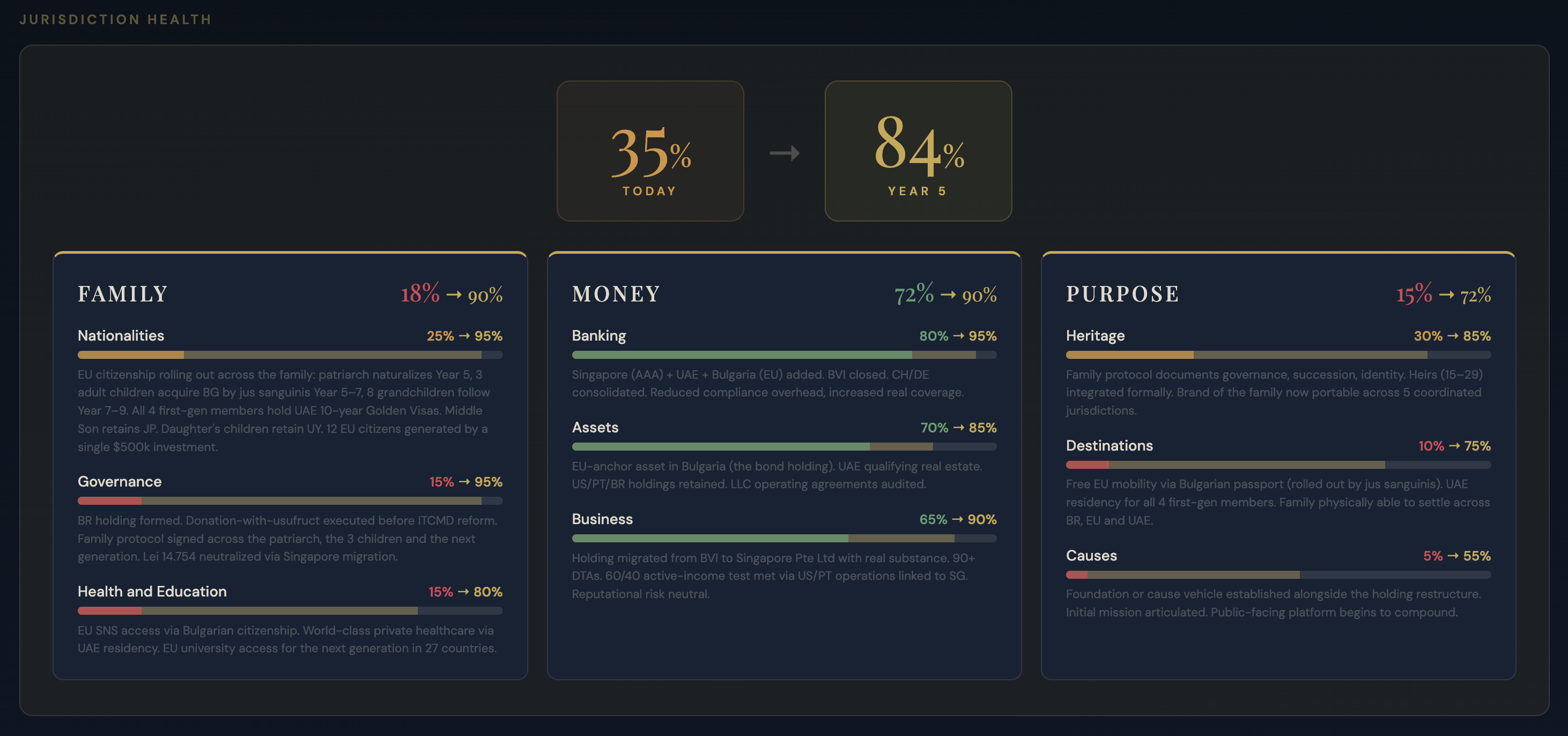
The ideal map depends on each family's objectives, but we can tell whether a map is healthy or not. This is how we know what to improve. First, we read your current map. Then we identify what each new position would change for your safety, your finances, and your way of life. We give you the full picture of what each move costs and what it returns in your Jurisdiction Control Centre, which you can see below. This is a snippet of how one family improved their Jurisdiction Health:
Global Hedging.Looking at the world with Jurisdiction eyes.
Your Jurisdiction Map needs a Vault, a Forum and a Refuge in different jurisdictions. The Vault and the Refuge must not share a protector: under one security guarantee they count as a single position. Many families also spread the positions across both hemispheres, so their presence can reach the world's opportunities and diversify against its risks. This is one example based on common choices:
Your Starting Position.Examples by home country.
Where a family starts changes its first map. These are three typical client origins, each with a Vault, a Forum and a Refuge in three different jurisdictions.
Where to start.The most valuable jurisdictions. A family with one jurisdiction adds its second from here.
Each of these jurisdictions can fill more than one position, and each holds one position in a given plan. A family that starts here has done a substantial part of the work in a single step.
To complete the plan.Harder or costlier routes into the same jurisdictions, for the position the first step left open.
Once the family's most pressing position is held, these routes fill whichever position is still open.
Case by case.For families whose specific situation is better served by jurisdictions outside the first two lists.
Families with specific circumstances may be better served by jurisdictions outside the first two lists. Each case is evaluated on its own.
Beyond programmes.Why Jurisdiction Planning has become necessary.
Financial services produced the multi-family office when families needed an advisor who sold no product and could weigh the banks against one another. Residence, citizenship, banking and structuring have reached the same point. We are to investment migration firms what family offices are to banks: we sit on the family's side and weigh the providers against one another.
We do not stop when the passport arrives. Every jurisdiction drifts, so each position in a family's plan is reviewed on a fixed cycle, and every review is dated.
We choose and compare. Professionals licensed in each jurisdiction carry out what the plan decides and confirm that it is lawful there, and the plan records who stands behind each element and under which law.
When a provider pays us, the family sees the payment in full before it decides. Provider payments are part of how we are paid, so the family is not charged more because of them, and no payment decides which jurisdiction, provider or route we recommend. We advise a move only when the family is better off with it than without it after every fee is counted, and we have advised families to stay where they were.
More than fifty countries run investor programmes, and the ones that granted approval in weeks two years ago now take months or have closed. Families buying programmes off the shelf are buying doors to houses they have not inspected. Roughly US$90 trillion passes to heirs over the next twenty to thirty years, and where it lands depends on jurisdictions most families never chose.
Deep diagnosis of the three areas.Family, Money and Purpose: the specifics we examine.
The three areas we just outlined are the overview. The diagnosis is the deep version of each.
Where your offshore companies are incorporated, and what each one is for. Which banks hold each account, and under which reporting regime. Where you spend your holidays, and which jurisdictions you re-enter often enough to risk tax residency. Which cities are meaningful to your family: alma maters, hometowns, places of pilgrimage, family compounds. What diseases family members may have, and which jurisdictions treat each best. Which schools your children should attend, and where those schools' graduates settle.
Each area points to one of the three positions.
Each area opens into three sub-categories. Each sub-category names the specific interests that need a jurisdictional answer. The diagnosis reads your family at this depth across every jurisdiction you currently touch.
In a single short meeting we can read the full position of your family across all three areas and identify the moves that will most efficiently complete the picture. A different citizenship, residency, or filing changes tax planning, succession, hospital access, schools, banking, and assets: all of it together.
Monitoring the globe.The Geopolitical Order, the JP Success Index, and how we read the world.
We do not read your family in isolation. We read it against the world it lives in.
Between us, the four founders hold decades of senior experience across cross-border banking, sovereign-wealth advisory, geopolitics, and international tax, earned in Europe, the Gulf, Asia, and Latin America. Monitoring the globe is the founders' daily work, read for our own use rather than commissioned from an outside feed or research firm.
The world is entering a period of multipolar competition not seen since before 1945. We watch how it moves so the diagnosis stays current.
Three major economic blocs are competing for influence, capital, and talent across approximately thirty distinct economic zones and seven critical geographic chokepoints that determine trade, capital flow, and strategic leverage. We monitor how this competition shifts the conditions that jurisdictions offer to families. When a superpower gains influence over a zone, tax regimes tighten or loosen, banking regulations shift, residency conditions change, and enforcement postures harden or relax. A family's Vault and Refuge must not share a protector, so we read which power stands behind each zone. The Journal for Jurisdiction Planning publishes the same map openly: the thirty zones in JP Influence Zones and the narrows in JP Chokepoints.
The three positions are what a family builds. The JP Success Index, published by the Journal for Jurisdiction Planning, measures what each country owes the families it holds, and how close it stands to failing them.
It scores 173 countries from 0 to 100, with 100 the best, on four conditions, each with a breaking point at which the country has failed:
Sources behind the Index
Your Jurisdiction Control Centre.A continuously updated picture of every jurisdiction your family touches, scored and projected.
The Control Centre answers three questions, plainly. The first is where your family stands today across every jurisdiction it touches. The second is where it can stand in five, ten, or twenty years if you act, with what each move costs and what each move delivers. The third is what happens if you do nothing: which exposures compound, which windows close, which protections you lose.
The Jurisdiction Control Centre is a continuously updated picture of every jurisdiction in which your family has presence, exposure, or dependency. It shows your current position scored across Family, Money, and Purpose, and a projected position once the recommended moves are made. The Control Centre also shows an estimated horizon: how many years your family is set before any change is needed.
It tracks the jurisdictions you are currently exposed to and the ones you are considering, so you can see both opportunity and exposure forming before they arrive. Legislative changes, tax regime shifts, banking regulation updates, residency programme modifications, new financial hubs entering favourable cycles: tracked, interpreted, and surfaced as they happen.
Where one jurisdiction closes a window, another opens one. The same vigilance that flags exposure also surfaces emerging markets, new treaty regimes, and residency windows that compound for the families positioned early. The Control Centre is as much a record of where to move toward as it is of what to move away from.
Senior jurisdiction advisors maintain it and read it for you. When a new law, a geopolitical shift, or a policy window opens or closes, you do not interpret it alone.